Tuesday, 22 February 2011

Graffi-tee

An idea I had today about a project relating to young people and understanding their identity was Graffi-tee. 

Get a group of young people to bring in an old T-shirt and any images or textiles from home that they feel a connection with and help them to produce a piece of clothing they feel portrays their own identity.  By letting them see what's on the inside can be worn on the outside, it could help them understand and believe that they will be accepted for who they really are...

Year 2 - STUDENT PROGRESS REPORT

STUDENT NAME: Annahita Mackee

RESEARCH QUESTION:
How can traditional practices and culture be maintained with the use of crafting in contemporary society?

WHO ARE YOUR KEY FEEDBACK RESPONDENTS TO DATE? (individuals, companies, or interest groups):
Designer makers at Craft Central and Great Western Studios
Business support team and tutors at Craft Central
Researchers at Craft Council research centre

WHO ARE YOUR KEY COLLABORATORS TO DATE? (that is, people who are assisting you with artefact creation, surveys etc)
I have not collaborated as yet, I have written my own surveys, filmed the subjects myself and created my own artefacts, I will however need help from a graphic designer and editor soon.  I propose to ask my friends and colleagues for support.    

BRIEFLY, WHAT ARE YOUR KEY FINDINGS SINCE DECEMBER 2010?
Since December my question and artefact have evolved.  I am taking a keener interest in the community aspects of my project and how I can produce something or lead something that can make a difference in people’s lives. 
I have analysed my survey results, which narrowed down the scope of my question. 
I have developed new ways of displaying my process and journey.
I have decided and embarked on new research methods – video ethnography. 

WHAT ARE YOUR NEXT KEY ACTIONS?
To complete the video ethnography, and meet with a number of designer makers who are involved in community engagement craft projects.  To iterate my artefact from the findings of the video ethnography and interviews, specifically the key practices and cultural aspects that will redefine my question further.  Re-test artefact with my key respondents.  

PLEASE ALSO SEND WITH THIS FORM:
  • Bibliography  - I am maintaining a blog for my MADS journal which is fully indexed, I will print this out for the final exhibition.  I write my bibliography up every 3 months, these are my references to date.
WHAT ARE THE STRENGTHS OF YOUR PROJECT?
I am researching an interesting topic, which I am passionate about.  I have had goo and positive feedback and am now investigating further the ways in which my project could aid community engagement.

WHERE ARE THE GAPS IN, OR THREATS TO, YOUR PROJECT?
Time – it’s difficult to do my project in the evenings and on weekends, the participants and collaborators are usually only available during the day. 
I need to collaborate with a graphic designer and create a brief for the ‘kits’. 
Motivation and Momentum – there is an awful lot to be done, I need to ensure I keep going otherwise I will run out of time.  I have high standards and I really want to ensure that for the exhibition in December I can be 100% proud of what I have achieved. 

Monday, 21 February 2011

Threads of Feeling

Yesterday I visited the Foundling Museum again, to see their temporary exhibit, Threads of Feeling.  I found the exhibition really moving, as is the story of Coram's Foundling Hospital. 

The exhibition displayed pieces of fabric never shown before that were left with babies when their mothers abandoned them at the Foundling Hospital. I had previously seen the 'tokens' mothers left with their children, but these were things like the below:


Between 1741 and 1760 more than 4,000 of the babies left had a piece of fabric to identify them.  Some of these materials were of extremely high quality, there were ribbons, embroidered pieces, scarps tied into bows or made into rosettes.  

What I found extremely interesting were the number of community projects carried out by artists involved in the Coran charity.  

Stories of the World: London
This was a showcase of work by young people from certain London boroughs were either looked after children or care leavers.  They were joined by artists and encouraged to work with ceramics, painting, film, objects, sound and installations to create pieces that explored their identity and life in care.  I am interested in how getting involved in these crafting practices helping the young people understand themselves and their environments better.  

Relinquaries 
Another collection of items in the Foundling Museum had been created by young mums and young people currently in care, who had been adopted or live in supported housing from Coram.  They were asked to produce modern day tokens that were inspired by the items in the Foundling Museum, again exploring ideas around identity. 

I really enjoyed these projects that explored the relationship between crafting, the charity and vulnerable young people. I would love for my artefacts to be used to help vulnerable people, to get them to explore who they are and where they fit. 


Sunday, 20 February 2011

The Brit Insurance Design Awards

Another great year for the Design Museum's Design Awards exhibition.  This year was incredibly busy, combination of half-term and the exhibition being shown on the news apparently, with families running around everywhere, fighting over iPad games, a lot of the installations 'out of order' and no leaflet given to you on the way in, I bought the catalogue to really dissect what was on the shortlist.

Firstly, the design of the exhibition itself; this year the entries were still grouped into: architecture, fashion, furniture, graphics, interactive, product and transport; but they were displayed for the exhibition in the following themes: city, play, learn, home and share. 

The sustainable and environmental theme the was prevalent last year was a continued presence, but a new feature was the advances of the portable touchscreen technology, like the iPad.

The exhibition signage was interesting, printed text on canvas and material, overhead signage hung from wire like washing lines.  

Architecture
I was glad to see Living Architecture's Balancing Barn  and Concrete Canvas were shortlisted.  Both projects that I was impressed by this year, but that fulfill completely different needs.  Living Architecture has created wonderfully the possibility for people to stay in buildings of real architectural value in the countryside without them having to be twee and period properties.  The guys at Concrete Canvas have created the most wonderfully innovative yet simple solution to shelter for humanitarian emergencies.

Fashion

Lanvin Spring/Summer '11 collection bright yet feminine and elegant.  


The Melonia Shoe made using a 3D printer/rapid prototyping machine!


Furniture
Spun, a sculpted, rocking, ergonomic chair, that is comfortable and functional.  Reminded me of the teacup ride!


Graphics
Marian Bantjes' I Wonder book was my favourite in this category, and has been a cherished purchase of mine this year.  Its filled with colours, textures and patterns that feel like you are spoiling yourself when you read it, hold it, buy it for yourself!  When I first bought it home it reminded me of the ornate manuscripts in the British Library, from times when the borders around the text were probably more important than the content itself!


Interactive
I was looking forward to experiencing Greyworld's 'Paint' for Nokia, which unfortunately was out of order when I visited; as was Wallpaper's Custom covers.  The majority of this section was iPad apps, which don't really inspire me, but this may be that it was hard to see any with the young members of the audience taking to these exhibits the most.  I did however enjoy Mimosa, an interactive artwork that mimicked petal configurations and reacted to movement.


Product
Pavegen really impressed me, a simple way to harness energy using paving slabs; the energy captured from footsteps can be used to power a light in the slab, as well as other street lighting, signage and local are information displays; to create a safer more energy efficient environment.


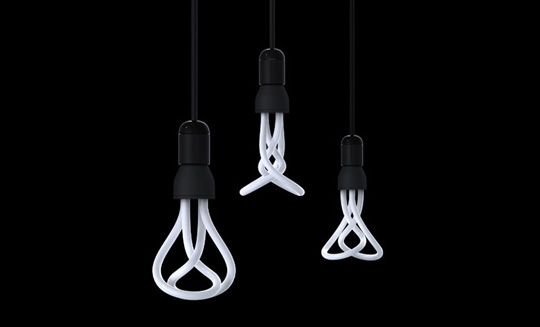
The other product I love, again because it is so simple yet perfect, and because lighting inspires me, is the Plumen 001.  The image below says everything you need to know.


Transport
The Barclays Cycle Hire has definitely changed the dynamic on London streets, I understand that the bikes themselves are a clever design, but somehow I feel encouraging people who are not necessarily 'cycle savvy' to ride through London traffic without helmets is such a great idea.  Considering the number of experienced cyclists with reflective kit and helmets that get hit by buses each year I think this is just a disaster waiting to happen.  It's also not reducing the traffic congestion in London anyway, and without cycle paths, is actually probably created more confusion.

Overall a great range of designs but somehow not quite as inspiring as last year.

Saturday, 19 February 2011

Drawing Fashion


 Over the past 30 years by Joelle Chariau of Galerie Bartsch & Chariau have collected some of the most beautiful fashion illustrations from the 1920s to present day, they have been displayed for the first time in the Design Museum.  The exhibition was so inspiring, there is something magical about the way certain artists can represent fabric, the human form, movement and style with just a few strokes.  The exhibition was very simple with the illustration presented on large frames that were covered in slightly transparent paper that was backlit.  There was also videos that were back projected onto this surface.


The works show illustrations from all the major fashion houses of our times and all the magazines whose images we have grown to love.  I had a few favourites, but overall, this exhibition really hit the spot for me.  All the images are iconic and give a real sense of the time in which they were drawn, you would have any of them displayed in your own home. 


The collection included illustrations from Lepape, Gruau, Antonio, Mats Gustafson, Francois Berthoud and Aurore de la Morinerie's wonderful monotypes.

Bocci


Friday, 18 February 2011

Livingstone's Medicine Chest

The Wellcome Collecttion, Science Museum, Natural History Museum, Royal Botanical Gardens and Horniman Museum are showing five objects that have never been displayed before.  Each museum writes its own interpretation of the objects meaning, and its interesting to see the different stories that resonate with their experts. 

 I saw Livingstone's Medicine Chest, which was full of old glass bottles of potions that were supposed to equip the explorer Algot Lange for his Amazonian expeditions. The booklet for this exhibit holds the stories from each of the museums above, with different interpretations on the anthropological importance, information on plant diversity, conservation and sustainable use, the science involved, how the object shaped our lives and much much more.  

I have been thinking about communication in my exhibition, with my artefacts, my journey, my research etc at my exhibition and this has really given me some more food for thought. 

Galeria.Solar.S.Roque by Manuel Maia Gomes

Absolutely enchanting


Thursday, 17 February 2011

High Society

Today I was back at my favourite place in London, the Wellcome Collection for their High Society exhibition. 

"With the illicit drug trade estimated by the UN at $320 billion (£200bn) a year and new drugs constantly appearing on the streets and the internet, it can seem as if we are in the grip of an unprecedented level of addiction. Yet the use of psychoactive drugs is nothing new, and indeed our most familiar ones - alcohol, coffee and tobacco - have all been illegal in the past.

From ancient Egyptian poppy tinctures to Victorian cocaine eye drops, Native American peyote rites to the salons of the French Romantics, mind-altering drugs have a rich history. 'High Society' will explore the paths by which these drugs were first discovered - from apothecaries' workshops to state-of-the-art laboratories - and how they came to be simultaneously fetishised and demonised in today’s culture."


My favourite installation was Biran Gysin's Dream Machine.  Gysin's installation aims to produce a 'drugless high' using a turntable, some paper, plastic and a light bulb!  You sit in front of the machine with your eyes closed while the light plays with you retina, and can apparently cause a hallucinatory effect.  

Wednesday, 16 February 2011

Bike spokes upcycled into handy oversized paperclips


Social entrepreneur Paole Richter has a keen interest in collecting old bikes and has started a program which gets the unemployed to restore and upcycle old bikes, most of which are sent to Africa.  The upcycled products include rubberbands from bike tires and the oversized paperclip (3") above from bike spokes. 

Who am I?

I am wondering whether my kits can help people explore their identity, their culture and their communities somehow?  Encourage people to engage more with the past and the world around them today?  These kits could be used with children in care, or those who have been adopted perhaps, to help them understand the world and how they fit in it.

Tuesday, 15 February 2011

Creative Communities

Feel slightly torn now between my original idea of a type of kit to encourage families and friends to create and communicate together; and a programme that looks at civic engagement through crafts.

I have been thinking a lot about a programme that would encourage communities to take part in activities and produce work that reflects their own experiences and places they live.  I would like to explore the role that crafts play in the social development of communities, but I am not yet sure I am willing to give up on my original idea.

We all know that getting involved in arts and culture stimulates conversations.  Can these dialogues be used to create stronger communities?  So do I want to create situations in which designer makers and craft enthusiasts are given opportunities that develop purposeful and deliberate debate in relation to the experience and community issues?  Dialogues about civic issues, policies, decisions about their areas etc. that help people understand themselves and their communities better.  They will develop new craft skills as well as gain confidence and learn how to lead and manage a group or project and communicate and negotiate with other members in their communities.

I am sure there are a number of designer makers in my area that specialise in participatory arts that can empower local people, create work that encompasses their diversity, and embed crafts into the key debates in the local area.

Reminded me of Slinkachu

Mini figurine jewellery

Saturday, 12 February 2011

Marsha of hold out your hand just saw my bit in the Craft Central newsletter and has volunteered to take part in my project! I really hope I get to visit her, as a houseboat in a village called Hoo sounds just beautiful!