Monday, 27 September 2010

Bright Light!

At 4am I awoke and could not stop my brain from spinning, as I had at last thought of a product for my MADS project, combining a modern material, with old crafting methods to produce a new product. I have come up with a weaved LED ribbon lampshade!


I have also thought of a chandelier design, and even a torch. The idea is that the structure itself emits light.

You could even make a torch using the old method of shoe lace key rings.

These structures could be used in the garden as the LED tape is waterproof! So you could hang them from trees, in a tent, from a sun umbrella.

Sunday, 26 September 2010

Made Not Manufactured

Origin is the Crafts Council's annual showcase of original contemporary craft, there were over 2o0 of the most innovative UK and international makers in the Old Spitalfields Market for us to enjoy. Here are some of my favourites:

Claire Brewster

Birds flowers and insects majestically come to life from the pages of old maps and atlases.


Debbie Smyth

Playful contemporary artworks created by stretching a network of threads between accurately plotted pins.

Joanne Tinker

Delicate sheets of recycled chocolate foil wrappers are transformed into jewel like sculptures and textures.

John Moore

Moore's distinctive designs explore form colour and movement through the repetition of shapes in aluminium and silver. He uses car spray paint to create an amazing finish to pieces that can be worn in a variety of ways. He was a wonderful inspiration, he very kindly explained his work to us and showed a real interest in our creative pursuits.

Sarah Morpeth

Sarah’s handmade books incorporate a range of textile methods and traditional bookbinding techniques. Using machine and hand stitch, folding and cutting, she explores the book form, creating sculptural and decorative pieces. The above is my favourite piece- Joan's Book

My perfect weekend culminated in a relaxing hot chocolate in The Vintage Emporium on Bacon Street, where a passing tourist set her bleached locks alight on the candle in the table!

Wednesday, 22 September 2010

Gareth Neal to Tom Dixon

Two very different vibes tonight, it started off in the Great Western Studios, only a few of the resident creatives were actually there, but there was free wine, a teenage DJ and some good guests artists, including Gareth Neal with his Urban Picnic. Most importantly, the atmosphere was warm, welcoming and unpretentious.

Our next venue was the very opposite. After a slightly unnerving walk along the canal, we found ourselves at The Dock, for the opening of Tom Dixon's new collection of accessories, lighting and furniture. The atmosphere here was was different indeed, firstly they had expected around 600 people, and over 2000 turned up, so there was a totally dry Champagne bar, and thirsty Shoreditch types can get quite narky, there was even a fight in the naan queue! After we battled the crowds through the small inter-connected rooms and checked out the over-priced carbon, we felt it was time to head home. The supposed emporium of creative talent felt more like a sanctuary for talentless lemmings.

Tuesday, 21 September 2010

From Cartoons to Creative Engineering

A great spot of midgeting at lunchtime! The Cartoon Museum on Little Russell Street is dwarfed by its neighbour the British Museum, but has an amazing collection of cartoons, with a good explanation of the history. So exciting to see these originals up close, with all there amendments, paper stuck on over errors, and later tipex! The collection goes through from the initial caricatures, to modern Beano and Dandy cartoons. My faves were the old political cartoons, that give you a great view of British history, fascinating even if you are not into politics. The current special exhibition is on Fougasse, full of the 'Careless Talk Cost Lives' posters from the 1940s, and a wonderful series of cartoons on the changing face of Britain during the war years. This was so enjoyable, I will definitely return in the next few weeks, as the collection requires a little more attention than one lunch break could provide.


In the evening I attended a lecture at The Royal Academy of Engineering, which promised to be so much more than it was unfortunately. The topic - How can creative engineering be harnessed to improve products and make a positive impact on our lives and society? Although a tremendously enjoyable and inspiring evening, the level that the lecture was directed at was unfortunately quite basic. I meet some great fellows at the Royal Academy, and the wine and canapes, partly made up for the lack of content in the lecture!

It did act as another reminder of how much I have to do for my MADS question, and a prod in the right direction. Things to note, the Cox Review of Creativity, the PWC Innovation Survey, and Gareth Jones 'Toolbox for Creative Engineering' as he called it. Which consisted of some core creative techniques:

- Brainstorming (post it notes are key here!)
- Use of Analogies
- The importance of being able to Sketch your ideas
- The quick and cheap Sketch Modelling
- Iterative Development

All of these have been part of the MADS journey so far, so although I do not know where my journey will lead me, at least I know I am doing the right things along the way!

A couple of thoughts i had after the lecture were, using nature as inspiration, and the idea of empathic research.

Gareth Jones discussed a number of inspirational case studies, my favourites were those from recent graduates, like Concrete Canvas, such a simple yet wonderful idea! Hopefully I will be getting some of those shortly!

Monday, 20 September 2010

Giant robots take on Trafalgar Square


Last night I went to see the Outrace project which opened the London Design Festival. These machines are usually found on an Audi production line, and create a light show of messages from observes, passers by, as well as from people online.

I actually got to see Clemens Weisshaar overseeing his robots in action!
If your message is chosen then the robots will write out the message, you can get a film of this emailed back to you.

I think it would be an amazing achievement to get an installation up in Trafalgar Square, something to aspire to, reminds me of my 4th plinth idea....

We ended the night with a lovely Laksa, mmmmmmmmmmmmm

Wednesday, 15 September 2010

What? Why? How? If? - Proforma Take 2!

Name: Annahita Mackee
Tutor: Richie Manu

WHAT

What is your main personal ambition?

To feel joy, love and passion. Expand and discover more about myself. Undo my conditioning, clearing personal and generational history and transforming myself.

What is your main professional ambition?


To find a profession that utilizes the best and most creative parts of myself; and affords me the opportunity to grow. To work for myself in an environment that attracts like-minded souls.

What is your main area of research interest?


Craftsmen, artisans, lost skills, storytelling through creating, learning from others, how crafting can have a social impact and benefit, how the internet has affected this.

What is your question? (Your question needs to ask, “how can” and must indicate the means as well as the end that you hope to achieve)


How can the internet help develop crafting without losing the interaction between people?

How can the internet help us develop our skills and engage further in activities we would otherwise not be aware of?


How can the internet be used to ensure crafting skills are passed down generations?

How can the internet help crafting leave its old-fashioned reputation behind and encourage a new generation to take up lost skills?

How can the internet help develop crafting into a more stylish and contemporary activity for everyone?


How can the internet affect crafting creative outputs?

WHY

Why do you think that this question will enable you to achieve your main personal ambition?

I believe my question will allow me to meet a wide range of people with a variety of skills that I can learn, it will allow me to create, and help me find my passion. I hope these new skills and my new found understanding of lost crafts will allow me to develop my creativity and myself.

Why do you think that this question will enable you to achieve your main professional ambition?

I hope to meet like-minded souls through this project and see how they make a living using their creativity, which will help me reverse my conditioning and allow me to fulfil my true potential. I hope to become aware of obscure crafts, learn new skills, build up a portfolio of work throughout the project and exhibit my work online and physically, allowing me to build a network of useful contacts.


HOW


How has your research informed your question so far?

My research so far has allowed me to search out lost crafting skills. I have carried out online research, as well as learnt new skills from reading books and attending workshops.

How will desk research inform your outcome?

Desk research will allow me to investigate lost crafts and skills as well as their position online and the availability of digital information and local courses. I will find the details of a number of craft cafes. Investigate the creative collaborations they have with skilled craftsmen and the workshops they have designed. I will also complete a variety of market research on what people are searching for online, the trends in crafting, forums, and physical venues. This will allow me to design an appropriate questionnaire, to hand out during my field research. Using the internet and books from the library I propose to create a number of artefacts to compare with those I create during my field research.

How will field research inform your outcome?


I hope that by collaborating with a workshop venue, meeting the people who run it, the trainers, and those that attend, I can develop my project with the help of my desk research. I will attend workshops, learn new skills, create artefacts from these skills, and compare them to what I can create from my online research. I have identified a number of venues who run exciting courses and already hand out a quick survey after the course, I hope to add a questionnaire of my own to get some feedback from the attendees.

How has your artefact extended your understanding of the potential of your question?


By creating a variety of items using different research methods, teaching myself and learning from others, whether it is virtually or at a workshop, I hope to develop a range of artefacts to demonstrate the development and conclusion of my research project.

How do you intend to develop the next stages of artefact iterations?


With the development of my skills and ideas I hope do produce a variety of artefacts throughout my journey.

How do you intend to ensure that your feedback will challenge as well as support your preconceptions?

I hope to get feedback from a variety of sources, designers, craftsmen, consumers and businesses. I think the views of different participants at workshops and online will challenge my preconceptions the most.

How do you know that the individuals and organization/s that you need to inform your research are prepared to co-operate?


I understand that there will always be some difficulty getting access to the appropriate gate-keepers, however so far I have not had that experience. I have spoken to a number of people who have already been very helpful with my field research. I have also visited the studios of a number of Creatives and as far as my research online, I have completed a course on Internet Insight and hope that will provide me with some of the skills required to really drill down into what people are saying and doing online in the crafting community.

How does theory play a role in the methods you are using to define, gather and analyze your research question? (Define which methods?)

I will initially use qualitative research techniques to look at, describe and understand the crafting skills, crafters as well as the different paths available to them. There will be a level of qualitative research into the beliefs and values of crafters and those not involved in crafting at all, which will allow me to form the questions, adn identify the sample group for the quantitative research.

How important is time planning to the achievement of your outcome and how have you worked out your strategy for using time (answer this with a fully worked out time plan)

Time planning is essential to ensure I schedule in the time needed for the desk research as well as the very time consuming visits to specialists to observe and learn new techniques. Without this I will not have the skills or the time to create and develop my artefacts.

How are you going to be able to manage the resource implications of your research strategy? (Answer this with a detailed budget)


My research project will have a variety of costs from courses and producing artefacts to postcards for the exhibition. See attached budget.

How do you intend to balance your research project with your commitment to the exhibition team (answer this with clarification of your role responsibilities and time allocation)?

I am fully aware of the time and responsibility planning an exhibition will take, and am really looking forward to applying the skills I use in my job (project management/PR/event planning) to help the exhibition team; this is included in my time plan.

IF

If all goes well where do you hope your mastery of your subject will position you at the end of the Course?

I look forward to the completing this process as I feel it will allow me to grow personally and professionally and lead me to some creative and productive answers as well as new questions! I would then like to develop these new questions after my course, one outcome I would like to achieve would be to set up my own portal or venue for people to come together to experience contemporary, stylish workshops with a social twist.

Number One London

I have at last made it to Apsley House, the terribly grand 'Number One London'.

I have passed it so many times, and at last I have now actually been inside the home to the Duke of Wellington after his victory over Napoleon at Waterloo, the interior of the house has been maintained and restored to ensure it looks very similar to it would have done at that time.

There is an amazing fine art collection, as well as wonderful collection of silver, and more obscure items, like Napoleon's death mask! A free audio guide provides a history of the house, its previous occupants and the many wonderful paintings and sculptures. The spiral staircase is watched over by Napoleon as Mars the Peacemaker by Antonio Canova. I most enjoyed the childhood memories from the current Duke of Wellington, as well as the stories he had been told as a child about different members of the household. Such as Napoleon's fig leaf falling off during the war!


After work I met up with someone on my course, I felt reassured that others are struggling with their projects, but didnt really help me progress any further.

Monday, 13 September 2010

Kit Kemp

My love for Kit Kemp and her wonderful style and creativity led me to another spot of lunchtime midgeting; an exhibition at Contemporary Applied Arts. The space was filled with one-off work from dozens of the top British craftspeople, commissioned by Kit, as she does for the Firmdale group.

As you enter the first thing you see is a bespoke plate wall installation, 100 makers were asked to create one plate each in the material of their choice: wood, ceramics, metal, textiles or glass. The effect is wonderfully overwhelming.


One of the lovely ideas launched at the event was that of Commissioning Craft, allowing you and me to get a wonderful bespoke piece made for our homes, with realistic budgets too!

I was most excited about seeing Gareth Neal's Traditionally Worn Louis side tables, there were just as beautiful as I had expected.

Saturday, 11 September 2010

Foundlings

I at last made it to the Foundling Museum, part of my bid to actually use my Art Fund card more.

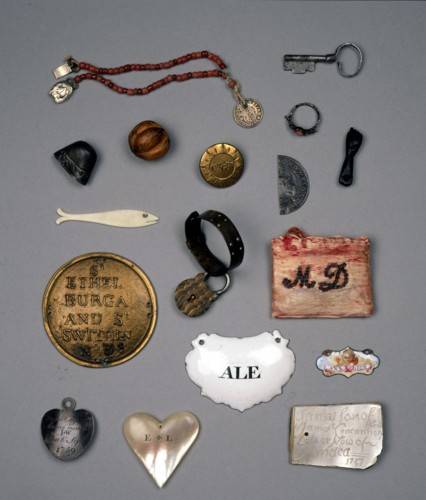
M came with me, and it was a beautiful day- weatherman was wrong again! The first floor showed a history of the Foundling Hospital, there were tokens left by mothers, to try and re-identify their children when they could afford to return, as all children were given new names. This was very moving, as these tokens, were never actually given to the children, as it was felt their identity needed to be protected. I was also obviously very interested in this because of my collections project, inanimate objects with such importance and meaning to only a few in the know. It was wonderful to see the generosity and hard work and campaigning of Coram, Hogarth and Handel.


The second floor was filled with beautiful art work. There were also some amazing pieces by the daughter of the secretary of the hospital, who had no formal training; and interesting links with Dickens and Oliver Twist.

At the very top of an impressive staircase was the Handel Collection, which fed my obsession with him -I have always been intrigued after studying the Messiah and performing it, which was written in an extremely short period of time, like a lot of his master pieces. The Handel Collection is located in a very peaceful room at the top and back of the building, filled with big red leather arm chairs with build in speaker.

After that we walked to Piccadilly for a few hours browsing in the giant Waterstones. I bought a couple of books, a Christmas present for a loved one, Ian Sinclair's 'Lights Out for the Territory' and Kristin Knox's 'Alexander McQueen, Genius of a Generation'.


Saturday night was filled with sofa, reading, and blue cheese.

Thursday, 9 September 2010

To Craft or not to Craft

Still struggling to find something I really connect with as the core of my research and design project. I have been thinking a lot about Craft and its importance in society, the social aspects, providing relaxation, confidence, ways to meet new people, learn new skills. Today I began to think about the importance I personally place on respecting others, awareness and access to all to art and crafts. I may now need to look along the lines of craft ad disability... or perhaps crafting for children in urban areas...

Sunday, 5 September 2010

I need to expand on previous ideas to ensure I find something to focus on. I know that I have a real interest in handicrafts, also the community aspect. I have really enjoyed the workshops I went on, hearing first hand how to do things, the history behind methods, the storytelling of crafting.

But then I am also interested in recycling/using waste materials to create new products, using old methods.

Wednesday, 1 September 2010

"KriskaDECOR® is a metal curtain is made from small interlinked pieces of anodized aluminium which form a lightweight, versatile mesh. It is a real metallic textile. You can create a completely smooth curtain or combine colours with logos, patterns, geometric shapes and reproduction of artworks. It is a suitable material for both interior and exterior use: it’s resistance to fresh and salt water, sunlight and rust. Also it is recyclable, very lightweight, easy to clean, hygienic and non-flammable."