Monday, 13 September 2010

Kit Kemp

My love for Kit Kemp and her wonderful style and creativity led me to another spot of lunchtime midgeting; an exhibition at Contemporary Applied Arts. The space was filled with one-off work from dozens of the top British craftspeople, commissioned by Kit, as she does for the Firmdale group.

As you enter the first thing you see is a bespoke plate wall installation, 100 makers were asked to create one plate each in the material of their choice: wood, ceramics, metal, textiles or glass. The effect is wonderfully overwhelming.


One of the lovely ideas launched at the event was that of Commissioning Craft, allowing you and me to get a wonderful bespoke piece made for our homes, with realistic budgets too!

I was most excited about seeing Gareth Neal's Traditionally Worn Louis side tables, there were just as beautiful as I had expected.

Saturday, 11 September 2010

Foundlings

I at last made it to the Foundling Museum, part of my bid to actually use my Art Fund card more.

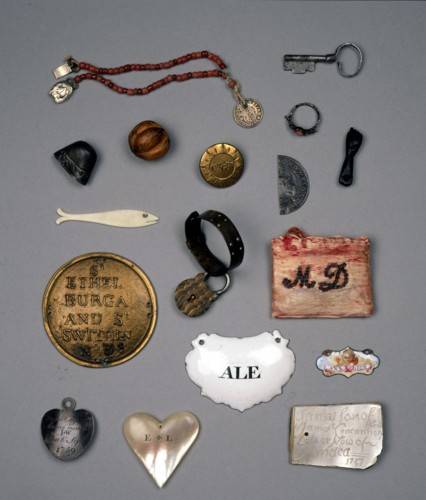
M came with me, and it was a beautiful day- weatherman was wrong again! The first floor showed a history of the Foundling Hospital, there were tokens left by mothers, to try and re-identify their children when they could afford to return, as all children were given new names. This was very moving, as these tokens, were never actually given to the children, as it was felt their identity needed to be protected. I was also obviously very interested in this because of my collections project, inanimate objects with such importance and meaning to only a few in the know. It was wonderful to see the generosity and hard work and campaigning of Coram, Hogarth and Handel.


The second floor was filled with beautiful art work. There were also some amazing pieces by the daughter of the secretary of the hospital, who had no formal training; and interesting links with Dickens and Oliver Twist.

At the very top of an impressive staircase was the Handel Collection, which fed my obsession with him -I have always been intrigued after studying the Messiah and performing it, which was written in an extremely short period of time, like a lot of his master pieces. The Handel Collection is located in a very peaceful room at the top and back of the building, filled with big red leather arm chairs with build in speaker.

After that we walked to Piccadilly for a few hours browsing in the giant Waterstones. I bought a couple of books, a Christmas present for a loved one, Ian Sinclair's 'Lights Out for the Territory' and Kristin Knox's 'Alexander McQueen, Genius of a Generation'.


Saturday night was filled with sofa, reading, and blue cheese.

Thursday, 9 September 2010

To Craft or not to Craft

Still struggling to find something I really connect with as the core of my research and design project. I have been thinking a lot about Craft and its importance in society, the social aspects, providing relaxation, confidence, ways to meet new people, learn new skills. Today I began to think about the importance I personally place on respecting others, awareness and access to all to art and crafts. I may now need to look along the lines of craft ad disability... or perhaps crafting for children in urban areas...

Sunday, 5 September 2010

I need to expand on previous ideas to ensure I find something to focus on. I know that I have a real interest in handicrafts, also the community aspect. I have really enjoyed the workshops I went on, hearing first hand how to do things, the history behind methods, the storytelling of crafting.

But then I am also interested in recycling/using waste materials to create new products, using old methods.

Wednesday, 1 September 2010

"KriskaDECOR® is a metal curtain is made from small interlinked pieces of anodized aluminium which form a lightweight, versatile mesh. It is a real metallic textile. You can create a completely smooth curtain or combine colours with logos, patterns, geometric shapes and reproduction of artworks. It is a suitable material for both interior and exterior use: it’s resistance to fresh and salt water, sunlight and rust. Also it is recyclable, very lightweight, easy to clean, hygienic and non-flammable."

Monday, 30 August 2010

Summer study period reflection entry

We have already had 2 months off for the summer, and this is one of the hardest times in the course apparently.  I can see the maintaining momentum could be an issue.  I started the summer with only a vague idea of what I wanted to do for my project.  I kept coming up with different areas of research and numerous questions.  I have therefore spent most of the summer just reading about each of the different topics, just to learn enough to know what I actually want to do.  

I started the summer looking at ways of combining new materials, technologies and processes with the older methods and skills.  

In July I went to some really great, free workshops at the Camden Arts Centre.  The workshops were made up of people who had given their time freely to discuss their past times and pass on their skills.  It was wonderful to be surrounded by passionate creative people, the atmosphere was wonderful and this really helped me decide that my research theme was most definitely going to be craft and the community. 

In August I was back to bouncing between the idea of producing something with smart materials that used old crafting skills.  But slowly my ideas came together and I began to realise that I could do this and include a community element as well.  

I am now at the point where I am considering creating a product that helps communities, families, groups of friends interact together, learn new skills and learn more about smart materials.  I think the perfect example of this is what Elena Corchero is doing with lost values.  Elena 'inspires a future where design is environmental and emotional yet smart and playful'. She has combined smart materials so simply with ethical and locally manufactured items.  Her values are wonderful, and I have been truly inspired by her business and her beautiful products. 

Monday, 23 August 2010

James Mylne


Met someone who knows this guys, amazing!

Saturday, 14 August 2010

Skin: The Wellcome Collection


The 'Skin' exhibition encourage you to look again or perhaps for the first time at the largest human organ. You travel through the ages considering the changing importance of skin, covering four main themes: Objects, Marks, Impressions and Afterlives.

It also investigates the skin as a living document: with tattoos, scars, wrinkles or various pathologies, which reminded me of the artist I saw that embroiders images of tattooed old skin.

The Skin Lab, featured artistic responses to cutting-edge research and technological developments in skin science from the mid-20th century onwards.

Monday, 9 August 2010

What is a Smart Material?

I have been looking at ways of using modern materials in crafting, so using tranditional techniques to make products out of materials that would never normally be used, and I have come across the phrase 'smart materials' a number of times.

"Smart materials are materials that have one or more properties that can be significantly changed in a controlled fashion by external stimuli, such as stress, temperature, moisture, pH, electric or magnetic fields."

Examples of Smart Materials

Piezoelectric materials
These materials can produce a voltage when stress is applied, the reverse is also true and so therefore they can be made to bend, expand or contract when a voltage is applied.

Shape memory alloys and shape memory polymers
Temperature changes or stress changes can cause deformations in these materials that can be induced and recovered.

Magnetostrictive materials
Magnetic fields can alter the shape of these materials and also their behavious in relation to mechanical stress.

Magnetic shape memory alloys
These materials alter in response to a significant change in the magnetic field.

pH-sensitive polymers
These materials trasform when the pH of their environment changes.

Temperature-responsive polymers
These materials are effected by changes in temperature.

Halochromic materials
These can change colour depending on a change in acidity.

Chromogenic systems
These materials can change colour in response to electrical, optical or thermal changes.

Photomechanical materials
These materials can actually change their shape under exposure to light.

Self-healing materials
These materials can repair themselves.

Sunday, 1 August 2010

Definitions of Craft

Craft
noun
1. skill or ability, especially in handiwork.
2. skill in deception and trickery; guile; cunning.
3. an occupation or trade requiring special skill, especially manual dexterity.
4. a) the members of such a trade, regarded collectively.
b) (as modifier): a craft guild.
5. a single vessel, aircraft, or spacecraft.
6. (functioning as plural) ships, boats, aircraft, or spacecraft collectively.
7. verb (transitive) to make or fashion with skill, especially by hand.

[Old English cræft skill, strength; related to Old Norse kraptr power, skill, Old High German kraft].

‘craft’ 2000, in Collins English Dictionary, Collins, London, United Kingdom, viewed 28 July 2010,

Craft
noun
1 a. a skill, trade or occupation, especially one requiring the use of the hands;
(b) in compounds needlecraft..
2. the members of a trade, as a body.
3. skilled ability.
4. cunning.
5. often in compounds a boat or ship, or an air or space vehicle spacecraft aircraft.
plural noun often in compounds boats, ships, air or space vehicles collectively.
verb (crafted, crafting) to make something skilfully.

[Anglo-Saxon cræft strength.]

‘craft’ 2001, in Chambers 21st Century Dictionary, Chambers Harrap, London, United Kingdom, viewed 28 July 2010,


Craft
noun
1.Natural or acquired facility in a specific activity: ability, adeptness, art, command, expertise, expertness, knack, mastery, proficiency, skill, technique. Informal: know-how. See ability, knowledge
2.Deceitful cleverness: art, artfulness, artifice, craftiness, cunning, foxiness, guile, slyness, wiliness. See honest, means
3.Lack of straightforwardness and honesty in action: chicanery, craftiness, deviousness, dishonesty, indirection, shadiness, shiftiness, slyness, sneakiness, trickery, trickiness, underhandedness. See honest
4.Activity pursued as a livelihood: art, business, calling, career, employment, job, line, métier, occupation, profession, pursuit, trade, vocation, work. Slang: racket. Archaic: employ. See action

‘craft’ 2003, in Roget's II The New Thesaurus, Houghton Mifflin, Boston, MA, USA, viewed 28 July 2010,


Craft
from Old English cræft strength, skill. The basic meaning of craft, common to most Germanic languages, is ‘strength’. In English it also acquired, as early as the ninth cent., the sense ‘skill, cleverness’. In reference to manual dexterity, this sense has retained a positive force; but in reference to mental agility, which may be viewed with suspicion or envy, it gradually became derogatory and by the 13th cent. often signified guile or fraud. The derivative adjective crafty developed in the same way; today it is used only in a negative sense.

‘craft1’ 2007, in The Penguin English Dictionary, Penguin, London, United Kingdom, viewed 28 July 2010,

Companies and Groups of Interest

Do the Green Thing

Lost Values

Green Unplugged

Glow in the dark plastic

"Thermoplastic Elastomers, or TPEs, are combining the properties of a thermoplastic with those of rubber. By varying compounds various demands can be met, to pose approvals for medical applications or for food contact, as well as resistance against UV and Ozone influence, extreme heat or cold, chemicals.
TPE's are easy to colour: fluorescent, metallic and pearl effect, glow in the dark."